from 15. Jan to 03. May 2026, from 9:00 to 18:00, Pentagonal Tower, Ljubljana Castle
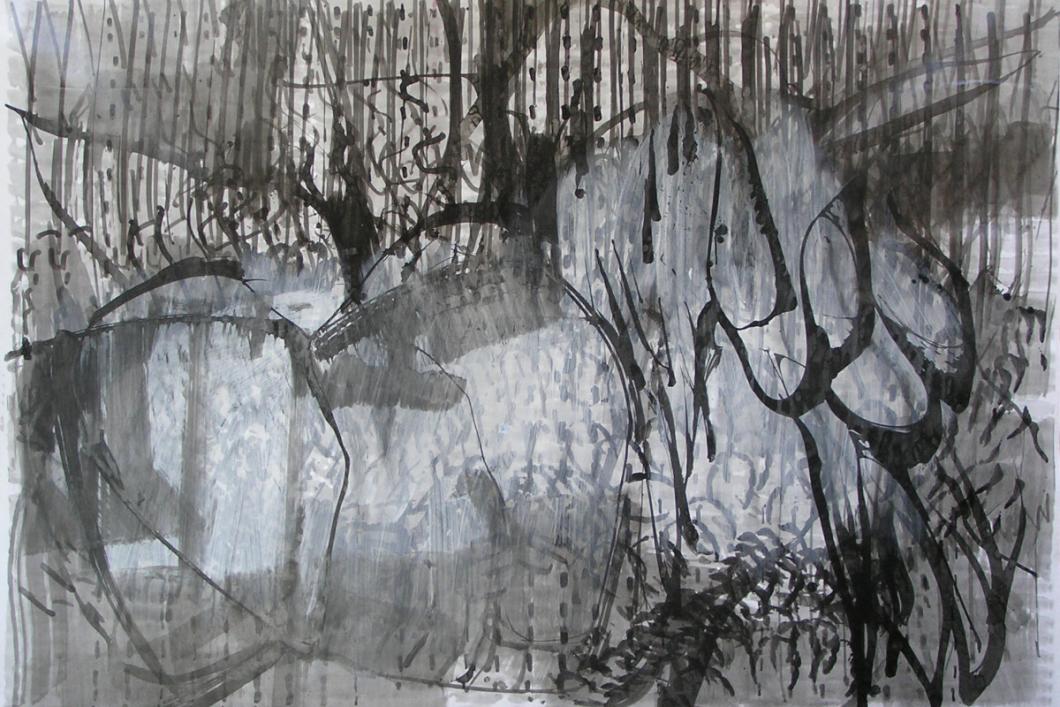
Vlado Stjepić is known as a painter with a distinctly dichotomous creative practice. In his oeuvre, he undertakes a thorough and subtle exploration of colour and its spatial dimension, which he contrasts with processual, spontaneous and palimpsest Indian ink works that form a unique zone between drawing and painting. Objects enter his work dialogically: as well as establishing an inner artistic dialogue with the artist’s own practice, they place this practice in the context of broader social reflection.
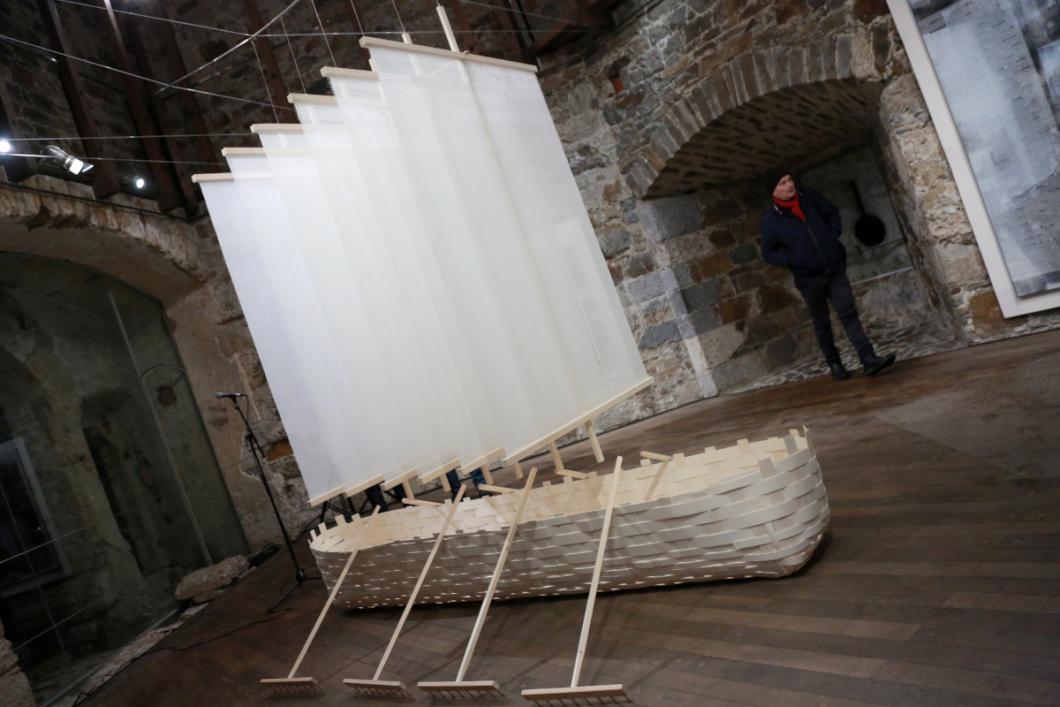
It is in this light that we can understand Stjepić’s installation Noah’s Apprentices. The title of the exhibition immediately places the exhibited object in a broader symbolic, culturally marked context. The boat that the artist places at the core of the space has an archetypal meaning with recurring patterns in various cultures, religions and myths. In Western culture and art, its symbolic role goes beyond the biblical interpretation associated with salvation, trial and promise. Through the literary classics, it has become a metaphorical image of last resort, (moral) trial and a place of archetypal struggle and perseverance. It enters the collective memory with the eternal images of Ahab’s boat from Moby Dick and the boat belonging to Hemingway’s stubborn old fisherman, Santiago. One could continue with images from films, all the way to contemporary art. The boat is a cultural concept and metaphor that can today represent a microcosm of the human community, a utopian collective refuge in the vast and uncertain terrain of the modern world, plagued by apocalyptic fears of war, environmental crises, and political and social conflicts. In such confrontations, we humans are no better equipped than apprentices, learning above all from our own mistakes and improvised solutions.
Stjepić’s boat is in every respect an imperfect, improvised, “apprentice” product: an almost weightless basket made of poplar veneer, with rakes for oars and sails made of permeable, transparent gauze, separated from the hull. Rather than a boat, this object is its antithesis: a construction of dysfunction, and thus also a dismantling of its established redemptive symbolism and the Romantic hope of renewal and new beginnings. In truth, Stjepić’s object is not a boat, but the apparition of a boat and a blind spot in the eye of humanity. At best, it is an open-ended “work in progress”.
The work is not simply a case of ambivalent social reflection, but rather an object of the artist’s personal “iconography”. Gauze – a material with a distinct symbolic character – is the artist’s preferred painting base, while the rake frequently serves him as a painting tool. Thus the material structure of the object enters into a reciprocal relationship with the paintings on the walls: from their perspective, the sails represent the whiteness of a yet unactivated painting surface, while the traces of the rake’s teeth sketch the laceration of strokes on thin Chinese mulberry paper. In the exhibition, the collective symbolic field intertwines with a personal, intimate creative space. The paintings are created in a complex network of events arranged through an improvised, partly unconsciously regulated palimpsest processuality. Their palimpsest structure is characterised by intermediate spaces: places of transience that arise between the construction and deconstruction of the image, between its erasure and the accumulation of layers. To put it slightly differently from the artist’s own written comments, the painting serves as a “time capsule” that enables a journey through one’s own temporality and history, while collective time is simultaneously inscribed within it on the symbolic level. Much like the metaphor of the boat, art is a form of epistemological search for meaning, exploration and cognition, a concept “in the making”, which is dismantled and re-established.
Stjepić’s creative practice is both exploratory and meditative, focused on seeking a fluidity between the body, the mind and the creative process. There is an “active illusion” in the work’s distinctly material experience. According to Robert Pfaller, this is an essential characteristic of play, which allows a rare opportunity for freedom, for the non-binding, enabling a withdrawal from the collective rituals of everyday life.