from 24. Sep to 15. Nov 2026, from 9:00 to 18:00, Pentagonal Tower, Ljubljana Castle
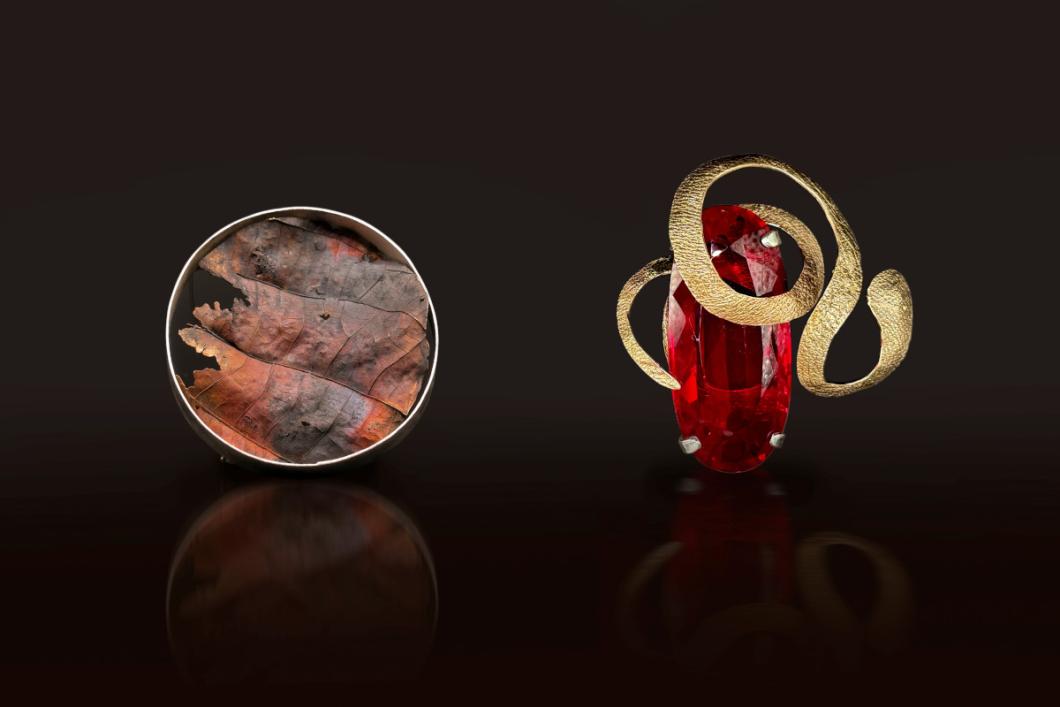
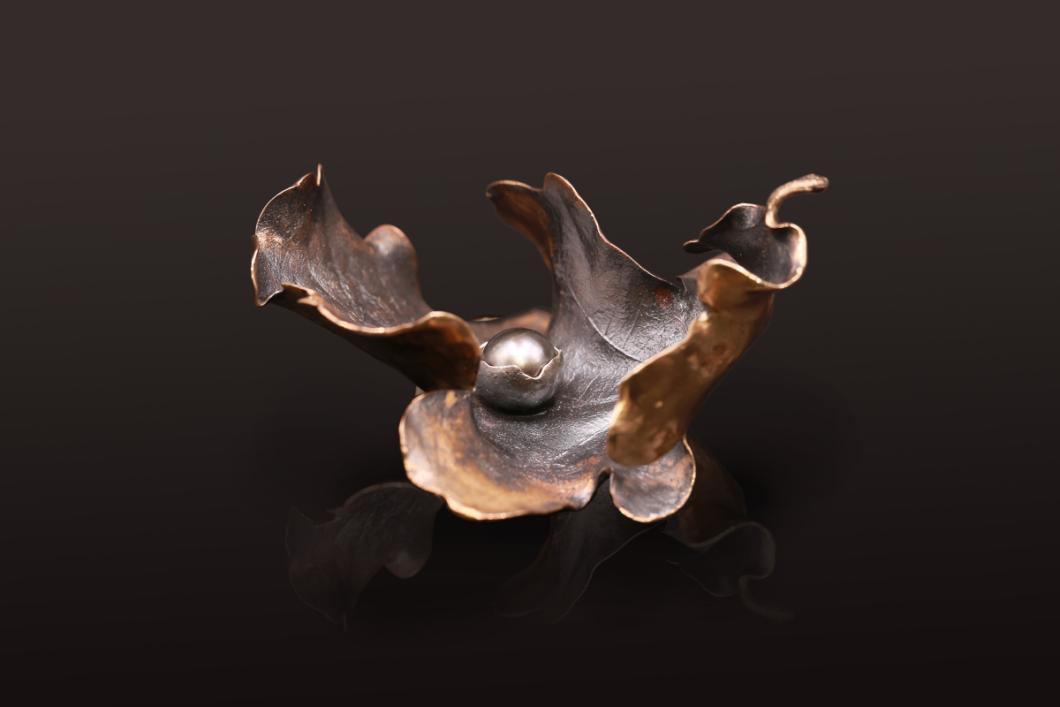
Maja Licul undoubtedly sees herself as harmoniously integrated into the jewellery tradition – and not only that. If one had to name the feeling that arises when looking at her works, the first word would be respect. I do not mean institutional respect, uncritical approval or bowing to authority; I mean respect in the broadest sense: a sensitive and attentive way of looking at the environment, the place we inhabit, our surroundings, from which we draw the strength to live, especially when it seems that we have to run ever faster to remain in the same place. This respect becomes visible in the motifs and forms of the artist’s works, in which natural objects are clearly recognisable: leaves, stones, twigs. Maja Licul uses strategies of adaptation and blending: natural forms shift from nature to culture almost unchanged. Leaf shapes and veins remain, surface textures remain – textures one instinctively wants to touch, feeling the drawing created by nature. The scale remains, with the dimensions subtly echoing the proportions of the human body. The desire to follow nature remains, to see its extraordinary diversity and, at the same time, its recognisability: there are no two identical leaves, yet no leaf seeks to exceed its own boundaries.
So it is here: the creator varies forms, crumpling them and using fragments, yet the origins of the forms remain visible. It is entirely clear that, for the artist, the human being is part of nature; everything – plants, animals, microorganisms and all of us – are particles of one vast network, and within this network no link is more important than another. This is not a place for egoistic boldness, for asserting oneself as the pinnacle of creation, or for shocking with radical gestures. What matters far more is the desire to merge rather than to stand out, the desire to be part of something rather than to oppose nature and culture.
At a moment when contemporary philosophy and cultural theory are shifting from the Anthropocene to the Chthulucene, when the human being is increasingly understood as one life form among fungi, spores, marsh plants or single-celled organisms, Maja Licul walks through the forest, gently and carefully transferring the surrounding environment to metal. Studying nature patiently, day after day, until a deeper understanding of the world reveals itself through observing its forms. Within her jewellery pieces, these repeated observations often transform into abstraction, a reduction and reinterpretation of forms. Immersing herself in the material, through the subtle transformation of natural shapes, Maja Licul conveys what she has understood, felt and discovered. This is yet another aspect where blending and respect come into play: the tradition of the jewellery craft. The artist uses traditional materials and casting techniques: we recognise bronze, silver, gold, pearls – materials used by jewellery makers since the very beginnings of the craft. This choice is meaningful as well: when everything is available, what we choose becomes extraordinarily important.
In a world that is rushing, shifting and chaotic, Maja Licul chooses to remain a calm and harmonious part of the flow.
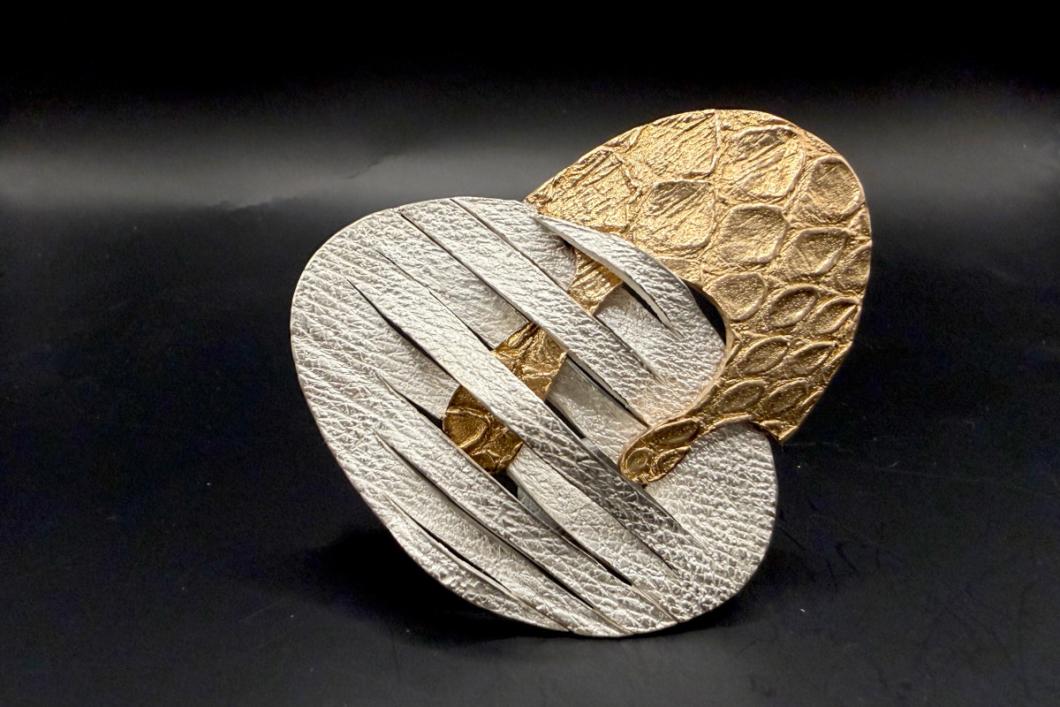
One of the archetypal ways of perceiving the world is the dualistic principle: good and evil, black and white, the bitterness and sweetness of life – opposites that are inseparably intertwined, forming a single whole. Aleksandra Atanasovski reflects on and speaks about the dualism and unity of life through symbols. More specifically, she focuses on one symbol with great precision: the snake – one of the most powerful images, simple yet extraordinarily rich in symbolic meaning. The snake is wise, yet treacherous; in legends and tales it may help a human, but it may just as easily kill them. It is a symbol of both death and rebirth; devouring its own tail, it signifies eternity. This interweaving of human and snake, this unity of opposites, unfolds in Aleksandra Atanasovski’s works in bronze, silver and at times gold, flashing with the red glow of precious stones and creating an impression of exotic luxury. The artist exploits tactility, sensitively and subtly emphasising skin in the junction of human and snake: human skin merges with serpent scales. Two skins become one – not contrasting but touching, blending. Skin, which has long been one of the artist’s primary media, becomes the unifying element that reveals how dualism and opposites can coexist within a single field; a field in which these concepts cease to divide and instead unite, allowing us to understand something about the world and ourselves that we had not known before.
These jewellery objects seem to possess their own powers; it feels as though, upon putting on a bracelet, the skin of your hand might grow scales, and you might slowly transform from a human into another being. The objects have a hypnotic strangeness that holds the gaze – as if reptile eyes were staring at you without blinking – yet they fully retain wearability. This balance between the magical and the recognisable, the earthly, is likely what creates the greatest tension, the force that captures the eye. The possibility of becoming someone else, or perhaps even entirely Other – is that not the greatest gift, granted only in dreams?
Aleksandra Atanasovski offers this lavish gift through jewellery, speaking of a world in which everything is one, in which magic still operates; a world in which the snake willingly offers its skin to the human.
The Echo of Two Voices From the very beginnings of original contemporary jewellery, the voice of protest has been clearly audible. It loudly declares: we (the creators) are different, we reject the traditional values of jewellery, we tear everything down and build anew. This is logical, as this branch of jewellery was born out of protest, out of the desire to shout loudly, asserting different values and different criteria.
Now, however, when there is no longer a need to loudly prove one’s truths, artists can once again find their place, combining tradition with freedom and speaking with their own unique voices. Maja Licul and Aleksandra Atanasovski do not seek to destroy or shock; quite the opposite. Through their works in the exhibition Ehosistem, they speak about a harmonious existence both within the jewellery tradition and, perhaps more importantly, within the world that surrounds us all.
Both artists construct the exhibition like a musical piece performed as a duet: they follow similar principles and work with similar methods, yet it is still a conversation between two fully formed personalities, two distinct voices speaking about what matters to both of them.
The creators devote great attention to nature, observing the surrounding world sensitively and subtly – and with respect. They see themselves as part of nature, not as its rulers. They place importance on the repetition of natural forms, not mechanically, but in a way that shows the abundance of possible variations of the same motif, all of them meaningful. Recognisable surfaces, patterns, the merging of leaf veins and human skin textures – because we are all particles of the same vast living universe, and an ant within it is no less significant than a human; every microorganism or insect has its place and its agency. It is also important that both artists value jewellery craftsmanship, striving for the highest possible level of technical execution.
These two voices do not sound in unison: they are artists who create differently, uniquely, working within the field of contemporary jewellery. In Maja Licul’s objects, leaves and twigs are filled with a desire to convey the harmony and beauty of nature through traditional jewellery means, to preserve simplicity while demonstrating technical mastery. Aleksandra Atanasovski, on the other hand, focuses on the image of the snake, speaking of it as a symbol of death and life, treachery and wisdom, embodying the unity of opposites.
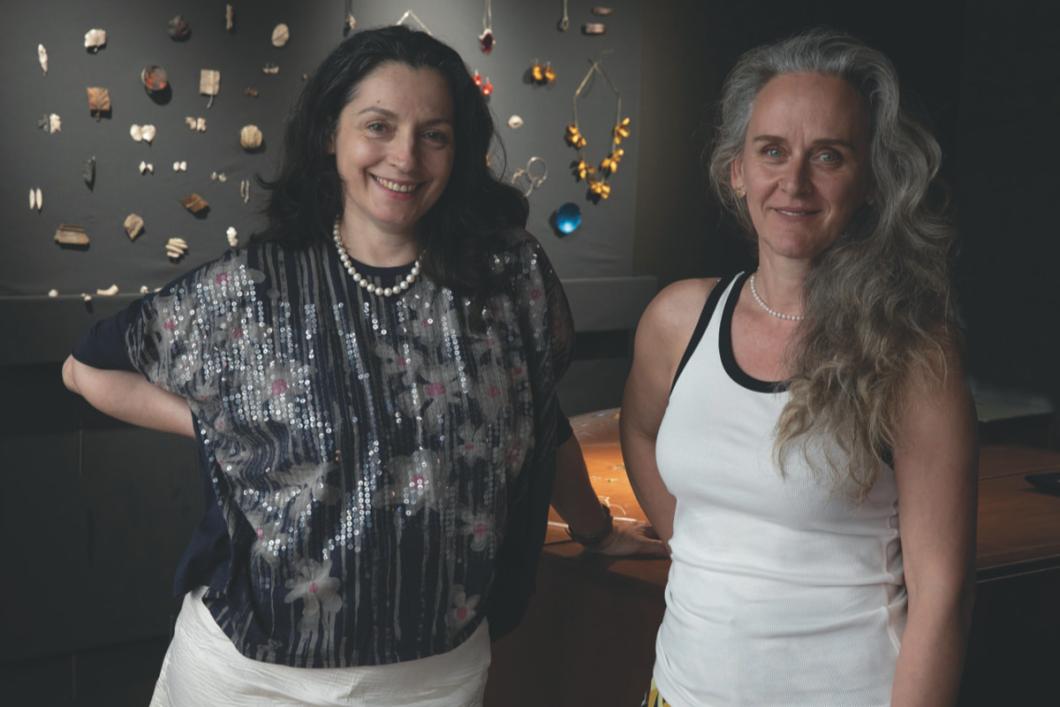
Looking at these objects is like listening to a conversation between two voices at a distance, when one voice calls out and the other responds: yes, I understand you, I hear you, I know what you are speaking about. It is no coincidence that Maja Licul and Aleksandra Atanasovski have been working together in the Eho studio for eight years; this is the echo of a dialogue, filling the ecosystem to which we all belong.
Exhibition Curator: Dr Jurgita Ludavičienė Art critic, professor at the Vilnius Academy of Arts (Lithuania) Chief Curator of the National Art Museum of Lithuania
Ehosistem, Maja Licul in Aleksandra Atanasovski. Foto: osebni arhiv avtorja
1 | 4
Skupni portret: Maja Licul in Aleksandra Atanasovski, Foto: Miha Fras
2 | 4
Maja Licul Hrast s perlo. Foto: osebni arhiv avtorja
3 | 4
Aleksandra Atanasovski. Foto: osebni arhiv avtorja